
The Overview
The University of New Mexico (UNM) operates a Reverse Osmosis (RO) skid with 18 elements to support its campus-wide power and steam generation. Fed by fluctuating groundwater (350–450 ppm), the system has grown over time to meet rising demand—expanding from 5 to 6 housings.
To boost output, the RO was pushed to high flux and pressure, leading to frequent cleanings and short membrane life. The University needed a solution that could increase throughput while reducing maintenance and extending membrane lifespan.
Our Solution
UNM approached Aqua Membranes looking for a solution that didn’t require new housings, pumps, or system redesigns. We met with their team to understand the performance pain points, gather water quality data, and assess system configuration. From there, we introduced our Printed Spacer Technology®.
Unlike traditional mesh spacers, our printed spacers are thinner (19.5 mm vs. the standard 28–34 mm) and more open, reducing pressure drop even at high active area. This design enables two major advantages:
- Higher throughput—more filtration media fits in each element, allowing the system to produce more clean water without expanding its footprint.
- Lower fouling and scaling—the open flow channels prevent dead zones where buildup typically occurs, extending time between cleanings and replacements.
We installed Aqua Membranes elements and supported system startup, collecting operational data to validate improvements. The results? Increased output, reduced maintenance, and longer element life—all without new equipment.
The Results
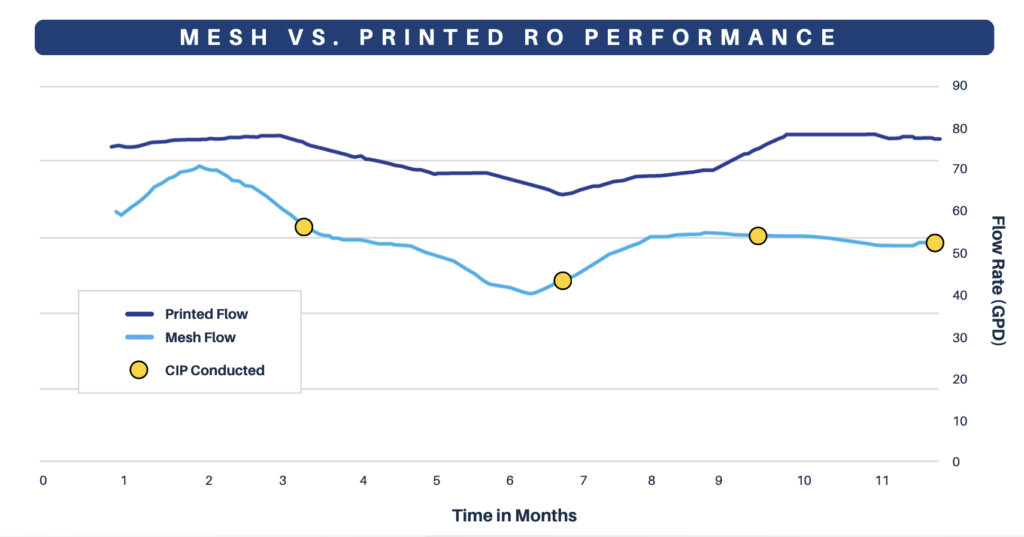
After just over a year of operating with RO membrane elements featuring Printed Spacer Technology®, the University has seen outstanding results. Previously, system output was capped at 54 GPM, with cleaning required every 3 to 4 months. Since switching to printed spacer elements, production has increased to 72 GPM—with no cleanings required after 12 months of runtime (see Figure 1). This upgrade not only resolved their output constraints but is also on track to quadruple membrane element life, while significantly reducing chemical and labor costs associated with RO maintenance.
Conclusion
Aqua Membranes’ Printed Spacer Technology® solved a long-standing performance challenge at UNM. Since adopting reverse osmosis, the facility had struggled to meet output targets and maintain consistent membrane performance. With the integration of printed spacer elements, the RO skid now exceeds output requirements and requires significantly fewer chemicals for cleaning. This improvement is projected to save the university tens of thousands of dollars annually in maintenance and operating costs.